
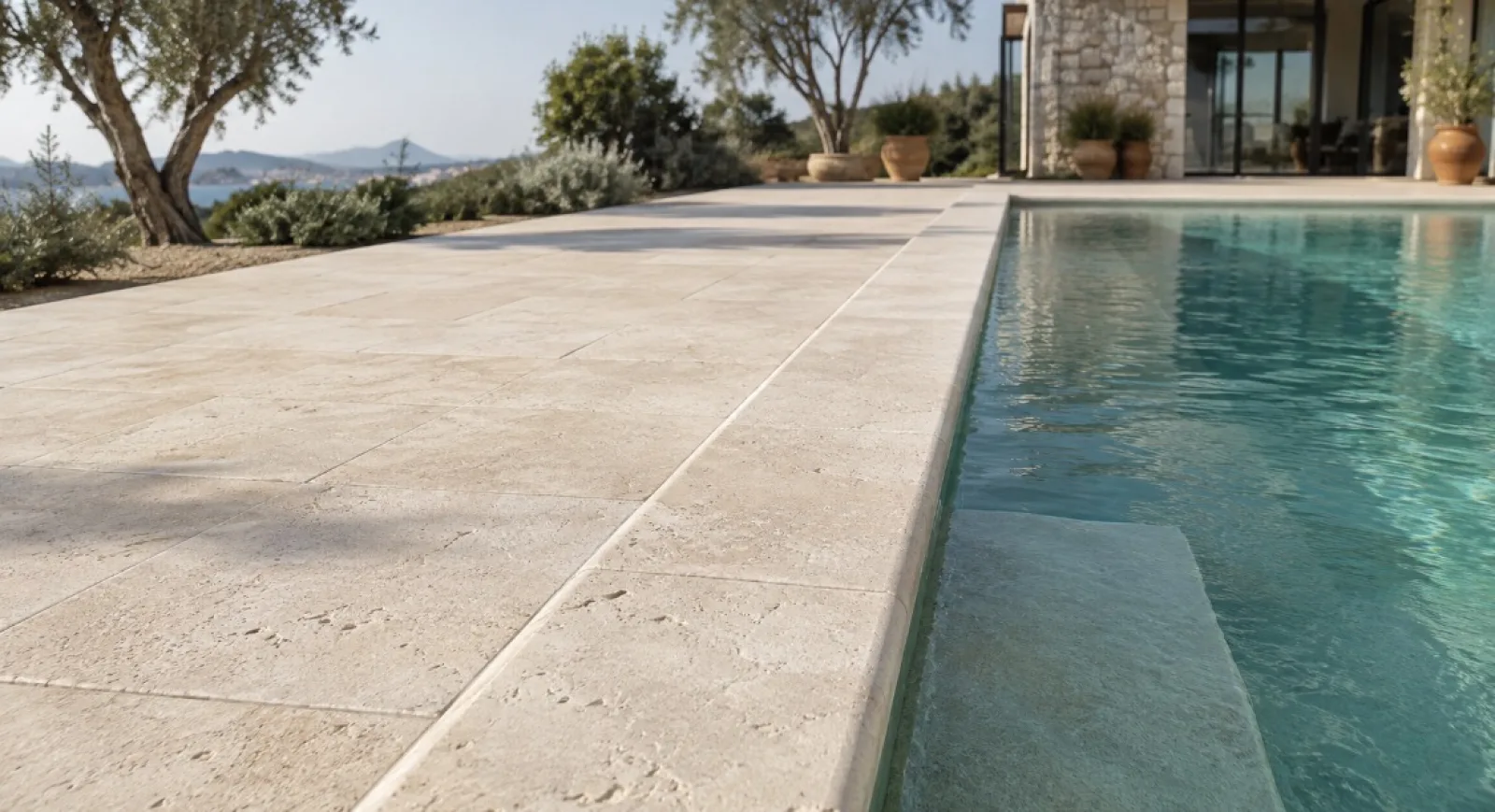
Turkish Travertine Pool Pavers & Coping: Buyer’s Guide
🖼️Blog Visuals
TURKISH TRAVERTINE FOR POOL PROJECTS: HOW TO MATCH PAVERS, COPING AND THE RIGHT SUPPLY SOURCE
Buying stone for a pool project should feel like a coordinated design decision, not a sequence of surprises. The material name may be simple—“Light Travertine” or “Ivory Travertine”—but the finished result depends on how the deck pavers, coping, corners, radius pieces, finish and shade range are brought together.
Most mismatches are preventable. A clear brief, an approved material range and one coordinated production plan make it much easier to protect the look of the pool from sample approval to container loading.
This guide shows importers, distributors, pool contractors and project buyers what to decide before requesting a quotation from Turkey.
THINK IN ONE POOLSIDE SYSTEM, NOT TWO SEPARATE PRODUCTS
The deck and the pool edge are viewed together, so they should be sourced with the same visual target.
A paver order might use 20 mm material over a prepared bonded substrate or 30 mm pavers in a mortar- or sand-set system. Coping is often planned at around 30 mm thick, with common widths in the 300–400 mm range and lengths around 600–900 mm. These are useful briefing ranges, not fixed rules.
What matters most is the relationship between the parts. The coping width must suit the pool wall and overhang. Straight pieces, internal and external corners, steps and curved sections need their own quantities. The paver module must meet the edge without awkward cuts.
When those decisions are made together, the stone can be selected and packed as one project rather than as unrelated products.
CHOOSE THE COPING PROFILE BEFORE COMPARING PRICES
“Standard coping” is not a complete production instruction.
A bullnose, eased edge and drop-face profile can use the same stone but require different cutting, finishing, construction and packing. Send a dimensioned section showing width, length, thickness, edge radius, overhang, drip detail if required, and the quantities of corner or radius pieces.
[INSERT COPING PROFILE SVG HERE]
IMAGE ALT TEXT: Bullnose, eased-edge and drop-face Turkish travertine pool coping profiles
CAPTION: Indicative coping profiles for briefing and RFQ use. Final dimensions should be recorded in the approved shop drawing before production.
A bullnose creates a soft, rounded touch edge. An eased edge gives a cleaner contemporary line while removing the sharp arris. A drop-face creates the appearance of a deeper, heavier edge.
For drop-face coping, the RFQ should state whether the product will be solid, laminated or mitred because the construction changes the cost, joint detail and production method.
FINISH IS A PERFORMANCE DECISION AS WELL AS A DESIGN DECISION
Tumbled, brushed and sandblasted finishes are commonly considered around pools. Some honed finishes may also be suitable for a specific project.
The finish name, however, is not proof of wet slip performance. The relevant evidence is a result for the actual stone and proposed finished surface under the test method used by the project.
For European external paving, the specification may refer to EN 1341 for natural-stone paving slabs and related methods such as EN 14231 for slip resistance. US projects may assess travertine characteristics under ASTM C1527/C1527M together with the applicable test methods.
Confirm the required test method and acceptance value once for the destination, contract and installation system, then use that requirement consistently when comparing sources.
Colour also affects the experience of the space. Light cream and ivory selections are often chosen for a brighter pool surround and may feel more comfortable than dark surfaces under strong sun, but no natural stone is universally “cool” or “non-slip.”
The useful buying question is whether the proposed lot, finish and test evidence fit the project.
FILLED OR UNFILLED TRAVERTINE: DEFINE THE FINISHED PRODUCT
Travertine’s pores are part of its character. They may be left open, factory-filled or filled during installation.
If filled material is required, the RFQ should identify:
The filler type and colour
The final surface treatment
Whether the finished product is intended for exterior and wet-area exposure
This matters because a small sample, an old technical report and the material offered today may not represent the same finished product.
Ask for source-specific documents where they are required—for example water absorption, flexural strength, abrasion, wet slip or freeze-thaw performance—and make sure the sample description matches the stone, finish and filling stated in the quotation.
THE APPROVAL THAT PROTECTS THE VISUAL RESULT
A catalogue image is a useful starting point, but natural stone is purchased from an available production range.
Before cutting begins, review current photographs or video of the proposed blocks, slabs, tiles or paver lot. Record the acceptable light-to-dark range, pore structure, veins, fossils and filler colour in writing.
Where possible, approve pavers and coping against the same reference and produce them from a coordinated source range.
After production, check representative finished pieces and make sure crates are labelled by product, size, profile and installation zone. This gives the buyer, producer and site team the same visual target.
MINI CASE: ONE POOL, TWO BEIGE TONES
Composite example based on a recurring procurement pattern; not presented as a named YaSeMarble client project.
A buyer approved light-beige deck pavers early in the project. Coping was added later from another supplier under the same commercial stone name.
Both products were acceptable on their own, but the coping was warmer, more heavily filled and visibly different next to the installed deck. Neither supplier had produced a defective product; the procurement brief had treated the pool edge as a separate purchase.
The correction was simple but costly: reselect the coping, make a second approval and delay the edge installation.
One shared colour reference, current-lot visuals and a combined paver-and-coping schedule would have exposed the mismatch before production.
COMMERCIAL PLANNING ANCHORS FOR AN EXPORT ENQUIRY
Buyers do not need a final freight calculation before making first contact, but they do need a realistic frame.
The following figures are practical planning anchors used by YaSeMarble. The dated quotation and order-specific loading plan remain the final commercial reference.
MINIMUM ORDER
Usually one full 20-foot container. Mixed products may be possible when the source and consolidation logistics align.
WORKING PAYLOAD
Often planned around 26–28 tonnes, subject to container tare, shipping line, destination and road limits.
APPROXIMATE 20-FOOT CAPACITY FOR 20 MM TRAVERTINE
Approximately 500–540 m² before adjustments for filling, coping pieces, special profiles and packing.
APPROXIMATE 20-FOOT CAPACITY FOR 30 MM TRAVERTINE PAVERS
Approximately 330–350 m² before adjustments for coping, custom pieces and packing.
TYPICAL PRODUCTION TIME
Commonly 2–4 weeks after the material, drawings, commercial terms and deposit are approved.
CUSTOM COPING AND RADIUS WORK
Additional time should be allowed for shop drawings, templates, complex profiles and approval samples.
A mixed paver-and-coping container will usually carry fewer square metres than a paver-only load because coping profiles, special pieces and protective packing change weight and crate efficiency.
For the calculation method, see YaSeMarble’s 20-foot container capacity guide for marble and travertine.
For the commercial sequence from enquiry to delivery, read the step-by-step guide to importing natural stone from Turkey.
WHY A MULTI-SOURCE SOURCING DESK CAN BE AN ADVANTAGE
YaSeMarble is not tied to forcing every specification into the output of one quarry.
That flexibility allows the sourcing process to begin with the buyer’s brief—colour range, format, finish, performance documents, quantity, target market and delivery plan—and then match it with a suitable Turkish source.
For qualified enquiries, YaSeMarble can coordinate current material visuals, source-specific document requests, paver and coping schedules, dated commercial terms, packing requirements and pre-shipment records.
The value is not a longer catalogue. It is a clearer match between the project specification and the material available now.
Explore Turkish travertine pavers for exterior projects, compare custom travertine pool coping options, or review Light Travertine and Ivory Travertine selections.
NOT READY TO REQUEST A QUOTATION? START WITH THE FREE CHECKLIST
Use the Pool Travertine RFQ Checklist to collect the dimensions and decisions your supplier will need.
It is a low-commitment way to organise the project before discussing price or availability.
LEAD-CAPTURE MODULE COPY
HEADING: Get the Free Pool Travertine RFQ Checklist
BODY: Plan paver sizes, coping profiles, finish, quantities, packing and delivery details in one two-page brief. English and Turkish included.
FIELDS:
Work email
Country
Project stage
BUTTON: Email Me the Checklist
PRIVACY LINE: We will send the checklist and relevant sourcing guidance. You can unsubscribe at any time.
TEXT LINK: Preview the Pool Travertine RFQ Checklist
READY FOR A SOURCE REVIEW AND DATED QUOTATION?
Send the completed checklist with your drawings, reference images and delivery location.
YaSeMarble can review the brief, identify suitable source options and return with current material information and a clearly defined commercial scope.
Request a dated quotation for Turkish travertine pavers and pool coping
FREQUENTLY ASKED QUESTIONS
CAN PAVERS AND COPING BE MADE FROM THE SAME SELECTION?
Yes, when the source, available lot, production schedule and required formats allow it. The safest approach is to place both products under one visual approval and one piece schedule rather than relying only on the commercial stone name.
WHAT COPING PROFILE SHOULD I SPECIFY?
Bullnose suits a soft rounded edge, eased-edge gives a restrained contemporary detail, and drop-face creates a visually thicker fascia.
The right choice depends on the pool build-up and design intent. Price comparisons require the same dimensioned section to be sent to every supplier.
HOW MUCH TRAVERTINE FITS IN A 20-FOOT CONTAINER?
As an early planning range, around 500–540 m² of 20 mm travertine or 330–350 m² of 30 mm pavers may fit.
Coping, filler, crates, special pieces and destination weight limits change the final quantity.
HOW LONG DOES PRODUCTION TAKE?
Standard orders are commonly planned at 2–4 weeks after approvals and deposit.
Custom radius pieces, complex drop-faces, approval samples or source availability may extend the schedule.