
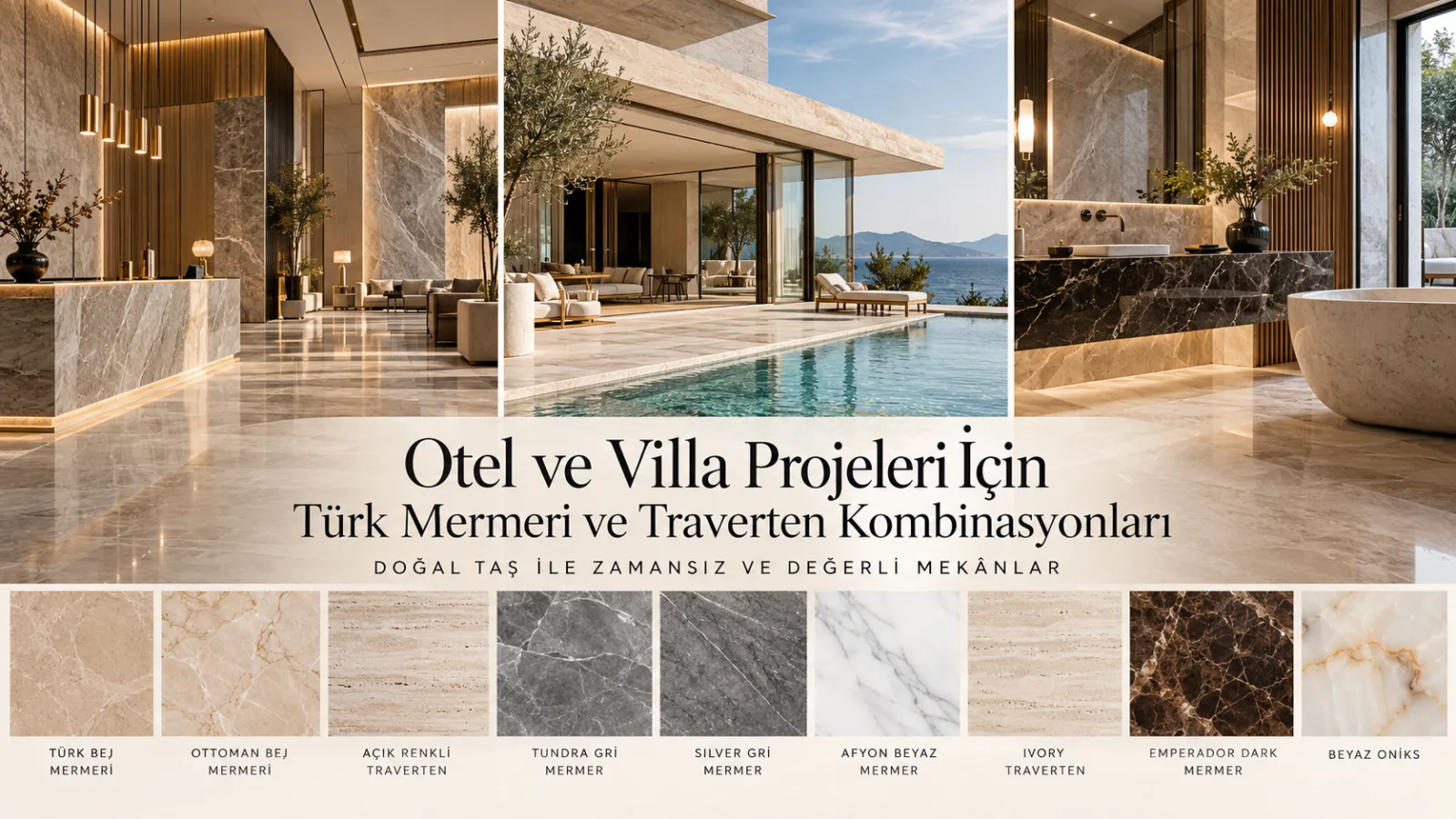
Turkish Marble and Travertine Combinations for Hotel and Villa Projects: 8 Materials Worth Considering
🖼️Blog Visuals
Turkish Marble and Travertine Combinations for Hotel and Villa Projects: 8 Materials Worth Considering
Turkish Marble and Travertine Combinations for Hotel and Villa Projects
Looking for the Right Natural Stone for Your Next Project?
Choosing natural stone for a hotel or villa involves more than finding an attractive colour. Architects, developers and contractors must consider visual consistency, technical suitability, material availability, fabrication requirements and overall project costs.
A well-planned combination of marble and travertine can create a distinctive architectural identity while allowing different areas of a building to have their own character.
For example, a villa might combine warm beige flooring with a feature wall in grey marble. A hotel could use light travertine in selected interior spaces and a contrasting marble for reception counters or decorative wall panels.
The challenge is finding materials that work together visually and meet the requirements of their intended applications.
YaSeMarble helps international buyers explore Turkish natural stone collections and sourcing options for residential, hospitality and commercial projects.
Planning a hotel or villa project? Explore the actual collections below and request a quotation based on your required stone, dimensions, quantity and delivery destination.
1. Warm Beige Marble and Light Travertine for Villas and Hotels
Design objective: A warm, coordinated interior with a natural Mediterranean character.
Beige marble and light travertine can complement each other when their colour undertones, patterns and surface finishes are carefully selected.
This combination may be suitable for villas, hotel rooms, reception areas and selected living spaces, depending on the technical requirements of each application.
YaSeMarble products to consider
A warm beige marble option for buyers considering flooring, wall applications and larger architectural projects.
A beige marble collection to consider for projects requiring a warm, refined colour palette.
A light-toned travertine option for buyers looking for a natural, neutral appearance across selected interior and exterior applications.
How to use this combination
Consider beige marble for flooring or selected feature surfaces, with light travertine for complementary walls or other areas where its appearance and technical properties are suitable.
Before ordering, compare actual material samples or current slab photographs. Beige stones can differ in undertone, veining and natural variation even when their commercial names are similar.
Looking for a coordinated beige stone selection? Share your project drawings, approximate quantities and preferred finishes with YaSeMarble to identify suitable options for evaluation.
2. Grey Marble and Grey Travertine for Contemporary Architecture
Design objective: A modern, understated palette with natural texture.
Grey stone can create a contemporary appearance in hotels, luxury apartments, villas and commercial interiors.
Combining grey marble with grey travertine can introduce variation without moving away from a consistent colour scheme.
However, not all grey stones have the same undertones. Some appear cooler or more silver, while others contain brown, beige or darker mineral movement.
YaSeMarble products to consider
A grey marble option for projects seeking a contemporary natural stone appearance.
A grey marble with silver-toned movement for selected floors, walls and statement surfaces.
A linear-patterned grey travertine option for architectural surfaces where directional veining is part of the design.
How to use this combination
Grey marble can provide a focal point for a reception area or interior wall, while grey travertine may be considered for complementary surfaces.
For large installations, review the actual material together under appropriate lighting. This helps identify differences in undertone, pattern and surface appearance before the final selection.
For flooring and wet areas, assess the proposed finish against the project's applicable slip-resistance requirements rather than relying on colour or appearance alone.
Request a comparison: Tell us which grey tones you prefer, whether you need slabs or cut-to-size products, and where the materials will be installed.
3. White Marble and Travertine for Luxury Interiors
Design objective: A bright, spacious appearance with contrasting natural textures.
White marble can introduce distinctive veining and visual movement, while travertine can add a softer, more textured appearance.
This combination may suit luxury villas, hotel bathrooms, selected reception areas and contemporary residential interiors.
YaSeMarble products to consider
A Turkish white marble option for projects seeking a light stone palette.
Another white marble collection to consider when comparing veining and tonal characteristics.
A light-toned travertine option for projects seeking a softer alternative to a predominantly white marble palette.
How to use this combination
White marble can be considered for feature walls, vanity surfaces or other selected applications. Ivory travertine may complement it in areas where its appearance and technical suitability meet the project requirements.
The important step is to review the actual materials together before approving the final combination.
Photographs can help with initial selection, but they do not replace sample approval where colour consistency and pattern are critical.
Planning a hotel or villa project?
You do not need to finalise every material before contacting a supplier.
Send your project drawings or material schedule to YaSeMarble to discuss suitable stone options, required formats and the information needed for a project-specific quotation.
4. Dark Marble and Light Travertine for Statement Spaces
Design objective: Strong contrast and a distinctive architectural focal point.
Dark marble can introduce depth and contrast into a space dominated by lighter materials.
Rather than covering every surface in dark stone, designers can use it selectively alongside beige or light-toned travertine.
This approach may be appropriate for reception counters, feature walls, decorative panels and selected residential interiors.
YaSeMarble products to consider
A dark grey marble option for contemporary and architectural interiors.
A dark brown marble collection for projects seeking a warmer, more traditional luxury palette.
A complementary light-toned option for balancing darker stone surfaces.
How to use this combination
Consider dark marble for a reception desk, selected wall panels or a focal surface, with light travertine in complementary areas.
The final selection should account for lighting, maintenance, surface sensitivity and the intended use of each material.
A dark polished surface, for example, may show fingerprints, water marks or scratches differently from a honed or textured finish.
The finish should therefore be selected according to the application rather than appearance alone.
5. Marble and Onyx for Bespoke Luxury Features
Design objective: A distinctive feature that becomes part of the project's identity.
Some projects require more than a coordinated neutral palette.
Selected onyx materials can be considered for decorative installations where translucency, colour and natural pattern are central to the design.
YaSeMarble products to consider
A white onyx option for selected decorative surfaces and potential backlit applications, subject to material evaluation.
A golden-toned onyx collection for projects seeking a warmer decorative effect.
How to use this combination
Onyx may be considered for selected reception features, decorative wall panels or bespoke interior installations.
Before committing to a design, confirm the actual material's translucency, structural condition, fabrication requirements and compatibility with the proposed installation.
Backlighting also requires coordination between the stone fabricator, lighting designer and installer.
Do not assume every onyx slab will produce the same illuminated effect. Review the actual material and approve the proposed arrangement before fabrication.
6. The Right Stone Must Meet the Requirements of Its Application
A visually attractive combination is not enough if one of the materials is unsuitable for its intended use.
Before approving natural stone for a hotel or villa project, consider the following requirements.
Application | What to evaluate before ordering |
|---|---|
Interior flooring | Traffic, finish, maintenance and wear requirements |
Bathroom flooring | Wet slip resistance, water exposure and cleaning |
Feature walls | Slab selection, vein direction, panel dimensions and installation |
Staircases | Thickness, edge profiles, dimensions and fabrication details |
Exterior terraces | Weather exposure, drainage, finish and local climate |
Pool surroundings | Wet slip resistance, water exposure and suitability of the proposed finish |
Reception counters | Surface sensitivity, cleaning and intended use |
Backlit onyx features | Translucency, structural condition and lighting design |
What about slip-resistance testing?
Slip resistance depends on several factors, including the material, surface finish, installation and conditions of use.
A stone should not be described as suitable for a wet floor or pool surround simply because it has a particular colour or texture.
For applications where slip resistance is a requirement, specify the applicable test method and performance criteria before purchase.
The relevant test results and technical documentation should be requested and verified for the actual product and finish. Availability of supporting documents must be confirmed for each material; they should not be assumed to exist for every collection.
This is particularly important for hospitality projects, where material selection must align with the project's technical specifications and applicable safety requirements.
7. How to Source Multiple Natural Stones for One Project
When a project requires several stone types, the buyer must coordinate more than colour and appearance.
Different materials may have different production requirements, dimensions, finishes and lead times.
A consolidated material schedule helps clarify what is required and supports more accurate quotations.
For each material, prepare the following information:
Stone selection: Preferred product name or reference photograph.
Application: Flooring, wall cladding, staircase, vanity or exterior paving.
Product format: Slab, tile, paving or cut-to-size.
Dimensions: Required length, width and thickness.
Finish: Polished, honed, brushed or another specified finish.
Quantity: Estimated square metres and, where relevant, piece counts.
Technical requirements: Applicable performance criteria and documentation.
Delivery destination: Country and delivery location.
Required date: Target delivery date or project schedule.
If the stone selection is not final, indicate which elements are still open to alternatives.
This allows the supplier to distinguish between confirmed requirements and design options that still need evaluation.
YaSeMarble's Cut-to-Size Marble and Cut-to-Size Travertine collections can be starting points for buyers exploring project-specific dimensions and fabrication requirements.
Final production feasibility, dimensions, material availability and delivery schedules must be confirmed for each enquiry.
8. Explore YaSeMarble's Project Portfolio
Material photographs are useful for comparing colours and patterns. Project imagery can also help architects and buyers understand how natural stone may contribute to a finished space.
YaSeMarble's online portfolio includes examples presented as a luxury villa interior in Dubai, a modern London apartment interior and a boutique hotel lobby in Bodrum.
Explore the YaSeMarble Projects & Portfolio to review the available project imagery.
When evaluating a reference for your own project, consider the intended application, selected stone, surface finish and overall design.
If you require a documented case study with confirmed installed quantities, project location and completion details, request the relevant information directly rather than assuming that all portfolio entries represent completed installations.
9. Request a Project-Specific Stone Quotation
The fastest way to evaluate suitable options is to share the requirements already available for your project.
YaSeMarble can review your enquiry and determine which product options and commercial details need to be confirmed.
To help prepare a relevant quotation, include:
1. Project type: Hotel, villa, residential development or commercial building.
2. Delivery destination: Country and, where known, city or port.
3. Required materials: For example, Turkish Beige Marble, Tundra Grey Marble, Light Travertine or Ivory Travertine.
4. Product format: Slabs, tiles, paving or cut-to-size.
5. Dimensions and thickness: If specified.
6. Estimated quantity: Square metres or piece counts.
7. Surface finish: As specified by the design or technical requirements.
8. Project schedule: Target delivery date and any relevant milestones.
9. Drawings or references: Architectural drawings, a bill of quantities, photographs or a material schedule.
If you do not yet know the exact stone name, send your reference images and describe the intended application.
The next step is to determine which materials are appropriate for further consideration and what information is needed to prepare a reliable quotation.
Have a hotel or villa project to source?
Send your drawings, material schedule or reference photographs to YaSeMarble.
We can review the information provided and identify the product availability, technical requirements and commercial details that need to be confirmed for your enquiry.
YaSeMarble — Turkish Natural Stones
Website: https://www.yasemarble.com