
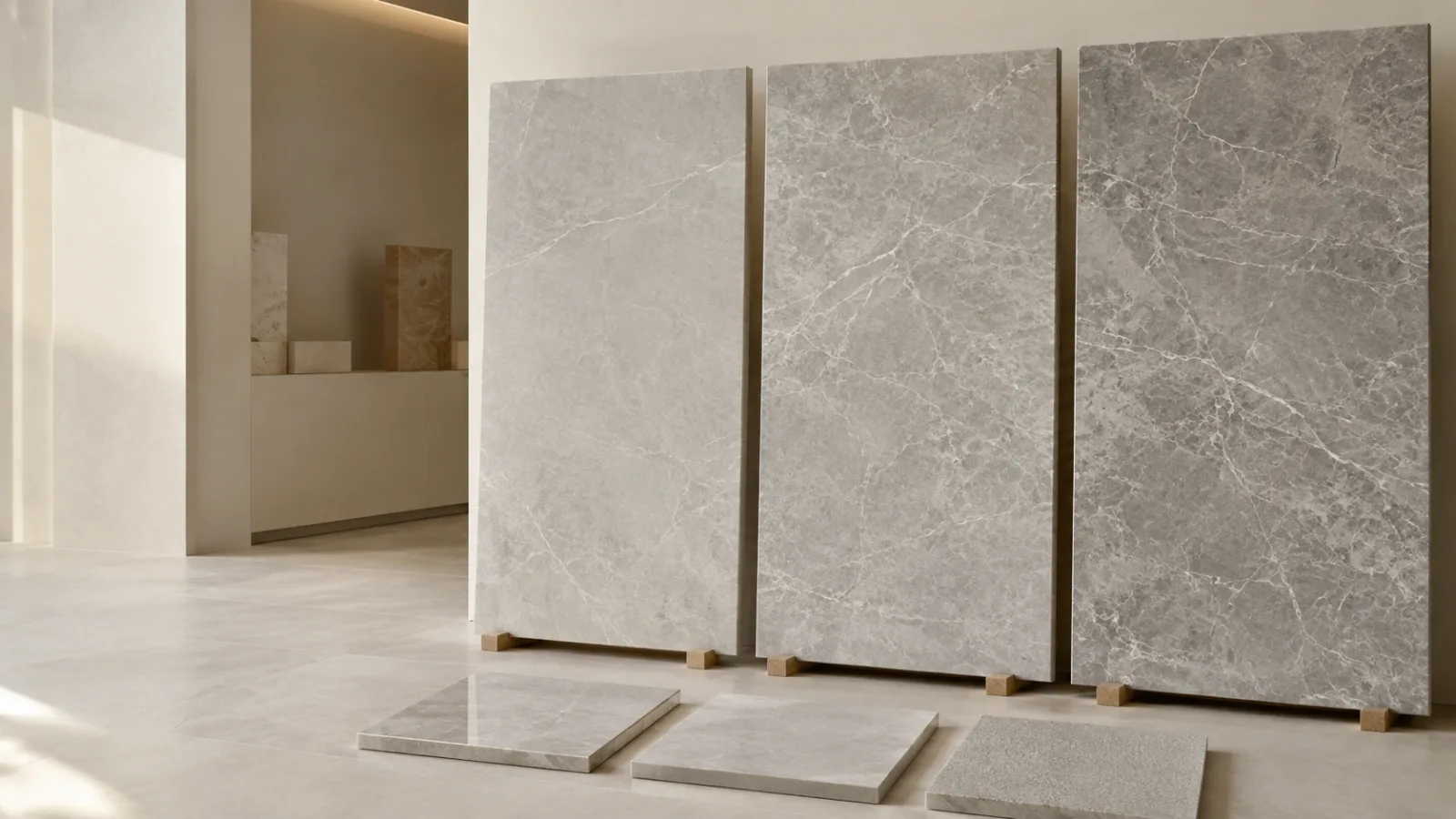
Tundra Grey Marble Buyer’s Guide
🖼️Blog Visuals
Tundra Grey Marble Buyer's Guide: Finishes & Specifications
Tundra Grey is one of Türkiye's best-known grey marbles. Its neutral background and fine white-to-cream movement make it easy to use across contemporary and classical interiors. That visual flexibility, however, creates a common procurement mistake: buyers assume that the commercial name defines the material.
It does not.
"Tundra Grey" is a trade name, not a performance grade or a fixed visual standard. Quarry source, block selection, slab treatment and finish can all change the final result. Before comparing prices, make sure every offer refers to the same product form, finish, selection range, source and commercial terms.
Where Does Tundra Grey Come From?
Tundra Grey is most closely associated with the Isparta stone-producing region, particularly the Aksu and Sütçüler areas. Some market offers also reference Afyon because blocks may be processed or traded through Afyon-based companies, and similar grey materials may circulate under overlapping commercial names.
Do not confuse the supplier's factory address with the quarry origin. Ask the seller to identify the offered source, current block or production lot, and processing factory in writing. The stone name alone is only the beginning of a specification.
What Defines Tundra Grey Marble?
Three visual characteristics usually define the material:
Background tone — a light-to-medium neutral grey field. Some selections lean cooler and more uniform; others include warmer, cloudier areas.
Vein pattern — fine white, cream or pale-grey lines that create a loose net-like movement. Vein density may range from sparse and quiet to dense and highly visible.
Texture and visible treatment — the stone generally takes both polished and honed finishes well, but the final appearance depends on the source and slab treatment. Ask whether the offered slabs are resin-treated, filled, repaired or mesh-backed, and make sure any visible treatment is included in the approval record.
Tundra Grey remains a marble. It should not be treated as a halfway point between marble and granite: it does not inherit granite's hardness, abrasion resistance or resistance to acidic substances simply because its appearance is restrained.
How the Finish Changes the Result
Polished Polishing deepens the grey field and gives the veins their strongest contrast. It works well for interior wall cladding, vanity tops, reception fronts and decorative surfaces. On floors, especially entrances or wet areas, appearance should not be the only criterion; scratching, wear and slip performance must also be considered.
Honed Honing creates a softer, matte appearance and reduces reflections. It is often chosen for contemporary floors, bathrooms and circulation areas. A honed finish does not automatically guarantee adequate slip resistance. For safety-critical areas, approve the actual finish and request the relevant slip-resistance value for the intended use.
Brushed or Leathered These finishes add texture and a low sheen. They can make fingerprints and minor handling marks less conspicuous, which is useful on counters and feature surfaces. They do not make marble stain-proof or acid-resistant. Sealing, cleaning requirements and a finish sample should be reviewed before approval.
Never leave the finish to a factory default. State it once, consistently, in the drawing, finish schedule, purchase order and approved sample record.
Where Can Tundra Grey Be Used?
Typical interior applications include:
Flooring and staircases
Wall cladding and feature walls
Bathroom walls and vanity tops
Reception desks and furniture surfaces
Cut-to-size architectural details
For kitchen counters and hospitality worktops, the client should understand that marble can etch when exposed to lemon, vinegar and other acids. A sealer may reduce liquid absorption and staining risk, but it does not prevent acid etching.
Exterior use must be assessed for the specific source, finish, thickness, fixing system and climate. In freeze–thaw climates, request frost-resistance results to EN 12371 and water-absorption results to EN 13755 for the offered source. Exterior paving, façade panels and steps also require application-specific performance review; the word "marble" is not proof of suitability.
Selection and Grading: What Does "First Quality" Mean?
There is no universal international visual grade called "first quality" for Tundra Grey. Each producer sorts its output against its own quarry and commercial categories. An adjective is therefore weaker than an approved reference.
For a defensible order, request:
Current slab, bundle or tile photographs from the offered production lot
Video showing more than one face—not only the most attractive slab
A physical range set representing the light, typical and dark limits—or the low, typical and high vein-density limits—of the accepted selection
Written rules for unacceptable features, such as excessive dark clouding, open fissures, heavy repairs or treatment outside the approved range
Disclosure of resin, filling, mesh backing and other structural or cosmetic treatments
Lot reservation and, where required, a numbered dry layout for cut-to-size work
For a small order, one block may provide the required quantity. For a large project, "single block" may be impossible or commercially wasteful. The practical requirement is a reserved production lot made from one block or a controlled group of matched blocks, all held within the approved visual range.
What a Quotable Tundra Grey Specification Looks Like
A serious factory can compare and price your requirement accurately when the RFQ includes:
Commercial name and exact source — Tundra Grey, with the offered quarry/source and producer identified.
Application — interior floor, wall cladding, stairs, vanity, exterior paving or another defined use.
Product form — slab, modular tile, cut-to-size panel or fabricated piece.
Dimensions and thickness — including dimensional tolerances where the project requires tighter limits.
Finish and edge treatment — stated once, with a reference sample or measurable surface requirement where necessary.
Quantity — net and order quantity in m², including the permitted overage or shortfall.
Selection basis — approved current photos, range samples, permitted variation and treatment limits.
Packing and identification — crate or bundle basis, piece numbering and dry-layout requirements.
Delivery terms — destination port, Incoterm with named place or port, and required shipping date.
Documents and test data — matched to the product form, destination market and intended application.
For EU construction products, the relevant Declaration of Performance and CE information depend on the supplied form and use. Common product standards include EN 12057 for modular tiles, EN 12058 for floor and stair slabs, EN 1469 for cladding slabs and EN 1341 for exterior paving slabs. These are product standards, not substitutes for individual performance tests. Depending on the application, the technical file may also need water absorption (EN 13755), flexural strength (EN 12372), compressive strength (EN 1926), abrasion resistance (EN 14157) and frost resistance (EN 12371).
Do not request every document indiscriminately. Request the documents relevant to the actual product, market and use—and make sure they relate to the confirmed stone source rather than a different quarry carrying the same trade name.
How YaSeMarble Verifies an Offer
Before order approval, YaSeMarble provides current photographs or video of the offered material, available dimensions and selection notes. Source-specific CE, Declaration of Performance and available EN test documents are checked against the confirmed producer and material source rather than substituted from an unrelated quarry.
For project orders, the quotation should also define the approved selection basis, packing, Incoterm, exclusions and validity. Buyers may request physical range samples or third-party pre-shipment inspection where the project requires additional control. See How We Trade for the commercial framework and the installation guide for site-stage considerations.
Frequently Asked Questions
Where is Tundra Grey marble quarried? The best-documented Tundra Grey production is associated with Isparta, particularly Aksu and Sütçüler. Some offers may reference Afyon-based suppliers or processors. Always ask for the exact quarry or source behind the quoted lot.
What makes Tundra Grey different from other grey marbles? Its typical combination is a neutral light-to-medium grey field with fine white, cream or pale-grey net-like movement. The balance between background tone and vein density varies by source and block, so the name alone does not define the selection.
Is Tundra Grey suitable for exterior use? Potentially, but not by name alone. Confirm the intended application, climate, finish, thickness and fixing method, then review source-specific water-absorption, frost-resistance and relevant structural performance data.
Should I choose polished or honed Tundra Grey? Choose polished when stronger contrast and visual depth are the priority. Choose honed for a softer, lower-reflection surface. For floors and wet areas, verify slip and wear performance instead of assuming that "honed" is sufficient.
Is Tundra Grey suitable for kitchen countertops? It can be used if the client accepts normal marble behaviour. Acidic food and cleaners can etch the surface, while sealing reduces absorption but does not make the stone acid-proof.
How can I keep a large order visually consistent? Reserve a defined production lot, approve current lot photos plus a representative range set, state the permitted variation in writing and use a numbered dry layout where panel-to-panel continuity matters. For quantities larger than one block can yield, require matched blocks within the same approved range.
Request Current Tundra Grey Photos and a Dated Offer
Send the application, dimensions, thickness, finish, quantity, selection reference, destination port and required date. YaSeMarble will check suitable current sources and prepare a written FOB, CFR or CIF offer with available material visuals and source-specific documentation.
Request a Tundra Grey quotation