
Marble for Hotel Projects: A Practical Specification & Procurement Guide
🖼️Blog Visuals
Marble for Hotel Projects: A Practical Specification & Procurement Guide
A hotel is not one material decision — it is eight or nine of them wearing the same PO number. The lobby floor, the pool deck, 200 identical bathrooms, a spa that has to stay slip-safe when wet, and a façade that has to survive a coastal winter all get specified on the same schedule, often by the same procurement team, and too often on the same one-line spec: "marble, similar to sample."
That single line is where hotel projects lose money and, occasionally, end up in a liability claim. Not because of the stone itself — because of the gap between what was approved on paper and what a tested, documented, dimensionally-toleranced specification actually requires. This guide walks through how to specify marble and natural stone for a hotel project zone by zone, what documentation genuinely applies, and what a supplier should be able to show you before you commit a container to it.
A note on scope: natural stone regulation, fire classification and slip-resistance testing vary by destination country and by the applicable building code. The standards referenced below (EN, DIN EN, EU decisions) are the commonly cited European framework; always confirm the equivalent requirement for your project's jurisdiction with your architect, testing lab or local code authority before finalizing a specification.
Why Hotel Specification Is Its Own Category
A villa buys one bathroom's worth of stone, once. A hotel buys the same finish across dozens or hundreds of identical spaces, on a fit-out schedule tied to a fixed opening date, under a brand standard that won't forgive a visible mismatch between Floor 3 and Floor 12. Three things change the brief:
Volume and repetition. The same stone has to read consistently across every guestroom, corridor and bathroom — matched block sourcing and control-sample approval matter more here than in almost any other project type.
Multiple zones, multiple requirements. Lobby, guestroom, wet area, façade and back-of-house each carry a different finish, tested performance and durability requirement, even when the design brief calls for "one material family."
Schedule pressure. Hotel openings are fixed dates. A production or shipping delay on one floor's worth of tile can hold up handover for the whole wing.
Specifying for a hotel means writing the brief per zone — and backing each zone's finish choice with a tested value, not an adjective.
Match the Stone to the Zone
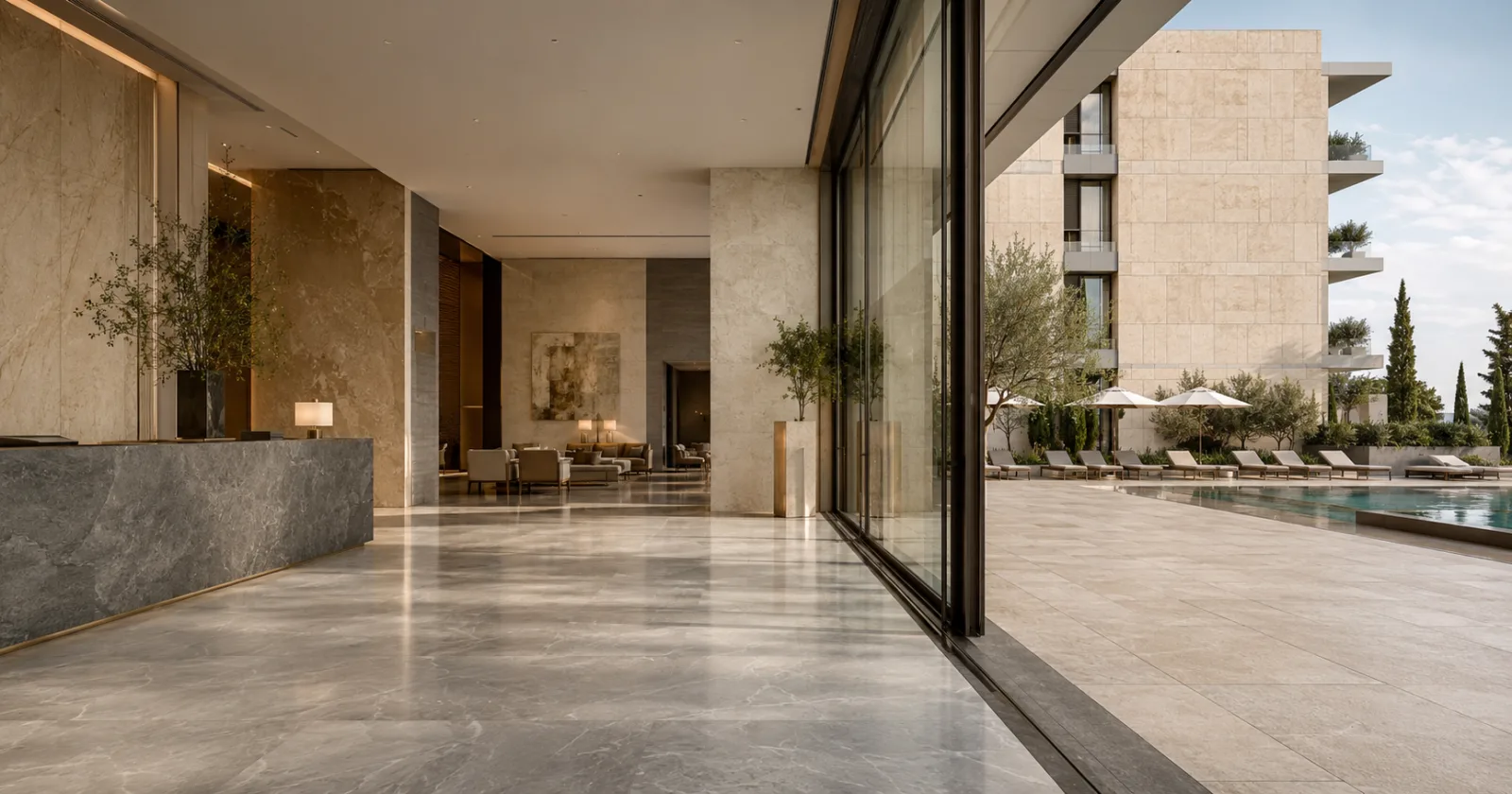
Lobby and public areas. Lobby floors are predominantly shod-traffic areas, but entrance zones are also exposed to rainwater, grit, tracked-in sand and heavy wheeled luggage — not a dry, low-wear environment by default. Polished Tundra Grey, Afyon White or a warm Turkish Botticino read as premium under lobby lighting, but the entrance zone specifically should be evaluated for wet-slip performance, abrasion and maintenance load, with matting or a honed transition strip where the specification calls for it — not selected on appearance alone. Baran Grey or Palladio Quartzite may also be considered for reception counters and feature walls, subject to source-specific confirmation of scratch, stain, etch, impact and maintenance performance for the exact material offered.
Guestrooms and bathrooms. This is where lot matching decides the project's visual outcome. A calmer, lower-movement stone — Afyon White, a Denizli-region travertine, or a consistent-tone beige limestone — is generally easier to source in continuous, matched supply across a large room count than a highly figured marble. That said, no natural stone is guaranteed free of vein, fissure or tonal variation; the degree of acceptable variation should be agreed against a control sample before production, not assumed from the stone's name.
Spa, pool deck and wet areas. Do not approve a wet-area floor by finish name alone. Brushed travertine and honed or bush-hammered limestone are common choices for pool surrounds and spa floors because they generally test better wet than a polished surface — but "honed" or "brushed" is a texture description, not a safety guarantee. A honed stone can still test unsafe wet. Flamed (thermal) finishes are not suitable for every stone type — the heat treatment can cause surface spalling or micro-fracturing in some marbles and resin-filled travertines, so flame-finish suitability should be confirmed through producer review, trial processing and applicable performance testing for the specific material before it is specified. See the slip-resistance section below for what to actually ask for.
Façade and exterior cladding. Stone name alone does not establish façade suitability. A hospitality façade specification should also define: flexural strength under EN 12372, breaking load at the dowel hole under EN 13364 where dowel-fixed panels are proposed, and separate structural verification of the complete panel-and-anchoring system by the project engineer — a stone test result on its own does not certify the fixing system. Add water absorption and freeze–thaw performance for the climate, salt-crystallization resistance for coastal or de-icing-salt environments, panel thickness and maximum panel dimensions, vein orientation, and whether the panels are resin-treated or mesh-backed. Denizli-region travertine and beige limestone are widely used in hospitality façades, but the engineering package — not the stone type — is what makes a given panel suitable for a given building and climate.
Back-of-house and high-traffic corridors. A more economical visual selection — calmer veining, lower grade band — may be acceptable in back-of-house areas without the guest ever seeing the trade-off. Dimensional tolerances, slip performance, abrasion resistance, chemical resistance and cleanability should not be relaxed just because the visual grade is lower.
Finish and Tested Slip Resistance
One of the most consequential hospitality specification errors is choosing a finish for how it photographs rather than for a tested result. A polished marble floor at a pool deck or spa entrance is not a design preference; it is a foreseeable safety issue.
Slip resistance should be requested as a tested value for the exact stone and exact finish being quoted, using the test method and acceptance threshold required by the project's jurisdiction — not a default assumption:
EN 16165:2021 is the current European standard and defines four test methods: Annex A (barefoot ramp test), Annex B (shod ramp test), Annex C (pendulum test) and Annex D (tribometer test). The core European standard reports a measured result; the familiar A/B/C barefoot categories and R9–R13 shod classes are retained specifically through German national provisions within DIN EN 16165, and are not automatically applied the same way in every European country. Confirm which classification system and minimum result your project's jurisdiction actually requires.
Legacy reports issued under the withdrawn DIN 51097 (barefoot) or DIN 51130 (shod, R-value) standards may still be accepted where the project specification or the competent local authority recognizes their equivalence — they are not automatically invalid. New testing commissioned today should reference the current EN 16165 or the applicable national adoption for the destination market.
For hotel entrance zones and corridors, use the test method and acceptance criterion required by the project's jurisdiction. The shod ramp test (Annex B) is a common reference but is not universally the mandated method for public pedestrian entrances — some authorities require the pendulum test (Annex C) or a different national method instead.
Ask for the report against the specific stone, finish and (where possible) the confirmed production source — a slip-resistance certificate for "travertine, brushed" in general is not the same evidence as one for the exact material being shipped. A tested result demonstrates compliance with the specified slip-performance requirement; it does not by itself guarantee the finished floor is safe in service, since drainage, installation slope, contamination and ongoing maintenance also affect real-world performance.
Interior dry-traffic floors — lobby interior, corridors, guestrooms — have more latitude to be selected on the design brief, but should still account for cleaning-chemical exposure and expected foot traffic volume over the life of the finish.
Visual Approval: Control Samples, Cut Direction, Fill and Backing
Four decisions should be fixed in writing before production starts, because each one changes what arrives:
Control sample. For any order beyond a small quantity, use a physical master sample together with approved range or limit samples as the contractual visual reference wherever practical — not a catalogue image or a sample from a previous year's block. Current slab and lot photographs or video are a useful supplement for remote review, but they should not replace the physical reference, since lighting, camera settings and screen calibration can distort color and contrast.
Vein-cut vs. cross-cut. For travertine and many marbles, how the block is sawn changes the pattern entirely — linear and directional (vein-cut) versus cloudy and non-directional (cross-cut). If the specification doesn't name the cut, the factory chooses it for you.
Filled vs. unfilled, resin-treated or mesh-backed. Define the finish once in the master specification, then repeat it consistently across the BOQ, drawings, schedules and purchase documents — a spec that says "honed & filled" while separate notes say "no filling material" is a common, costly contradiction. For large-format or thin panels, confirm whether resin treatment or fiberglass mesh backing is included, since this affects both performance and installation method.
Acceptable color/veining range. Natural stone varies lot to lot. Agree the acceptable range against the control sample, including how out-of-range pieces are handled (rejected, used in less visible areas, etc.).
Matched Lots, Tolerances and Approval Before Production
A private villa can work from "similar to sample." A 250-room hotel cannot. Where the brief calls for one visual family across many rooms or floors, source the quantity from a matched block group reserved before production starts, and confirm directly with the supplier whether later delivery phases will be filled from the same reserved lot or from separate production picked up later — the answer changes both price and visual risk, and should be agreed in writing before the first container is confirmed.
Beyond the block, confirm in writing:
Dimensional and thickness tolerances for the product form ordered (tile, slab, cut-to-size), and whether they comply with the dimensional and thickness tolerances stated in the applicable product standard and the project specification.
Edge profiles and shop drawings, approved before cutting begins — especially for stairs, pool coping, reception counters and any custom cut-to-size element.
Mock-up and dry-lay approval. For large-format floors or feature walls, a representative physical mock-up or dry-lay, photographed and signed off, should be included in the approval programme before full production begins.
Bundle, crate and (where relevant) room-by-room labeling, so installers can maintain the approved sequencing and blend across large areas rather than opening crates at random.
Quantity Planning: Net Area, Wastage and Spare Stock
The m² figure on a hotel RFQ should be net installed area plus an agreed wastage/cutting-loss allowance (commonly in the region of 5–10%, depending on pattern complexity, cut sizes and layout — confirm the figure for your specific layout with the fabricator) plus a spare-stock allowance held back for future repairs or replacements, since matching a discontinued lot years after installation is often not possible. State all three as separate line items, not a single rounded-up quantity.
Documentation Hotels Actually Need
Hospitality projects are more document-heavy than residential ones because contractors, certifying bodies and hotel-brand technical standards check compliance, not just appearance. Confirm which of the following apply to your project and destination market:
CE marking and Declaration of Performance (DoP) under the relevant harmonized EN standard for the product form: EN 12057 for modular tiles, EN 12058 for floor and stair slabs, EN 1469 for cladding, EN 1341 for exterior paving. The applicable standard depends on the product form, not the stone type, so check that the DoP matches what's actually being ordered.
Fire performance. Under EU Commission Decision 96/603/EC, certain natural stone products that meet specified conditions (composition, absence of organic binders/backing above defined thresholds, etc.) can be classified as A1 / A1fl without further testing; products that don't meet those conditions — including many resin-treated, mesh-backed or coated stones — require testing to determine their actual class. Don't assume a blanket fire class for "natural stone" generally; confirm the classification basis for the specific product being supplied, especially where resin, mesh or organic coatings are involved.
Slip-resistance test reports using the method and classification required by the project's jurisdiction (commonly referenced via EN 16165 and its national adoptions — see above) for the exact stone and finish used in each wet or entrance zone.
Water absorption and freeze–thaw data for exterior and coastal-climate applications, plus salt-crystallization resistance where relevant.
Origin and quarry documentation, increasingly requested where a project has sustainability or material-traceability reporting requirements.
A DoP relates to the declared product type, manufacturer and declared performance characteristics — it is not automatically a lot-specific test of the exact blocks shipping on your order. Separately confirm whether each supporting test report, particularly slip resistance, applies to the exact finish, treatment and product form being supplied, since surface-dependent properties don't automatically carry over between finishes of the same stone. If your project requires certification tied to the specific delivered lot, say so explicitly in the RFQ, since it may require additional project-specific testing and lead time.
The Hotel RFQ: What Gets You a Comparable Quote
Send this per zone (lobby, guestroom, wet area, façade, back-of-house) rather than as one line for the whole project:
Stone name and type, plus source/quarry region if known
Zone and application (lobby floor / bathroom wall / pool deck / façade cladding)
Product form (tile, slab, cut-to-size, paver) and cut direction (vein-cut / cross-cut) where relevant
Dimensions, thickness and required dimensional tolerance
Finish, stated consistently and unambiguously across the RFQ, BOQ, drawings and schedules (polished / honed / brushed / flamed), together with filled/unfilled, resin-treated and mesh-backed status where applicable
Net quantity in m², plus agreed wastage allowance and spare-stock quantity
Whether the order must be filled from one matched block/lot group across all delivery phases
Required tested slip-resistance value and method for wet or entrance zones, per the destination jurisdiction's requirement (commonly referenced via EN 16165 and its national adoptions)
Named delivery place/port, applicable Incoterms® 2020 rule, and required delivery phasing against the construction schedule
Required documents: DoP, applicable EN test reports, fire classification basis, and whether lot-specific (not just product-type) testing is required
Ten lines per zone is the difference between offers you can actually compare and numbers that stop meaning anything once containers are loading.
Shipping Terms and Container Planning
For containerized sea freight, the more precise commercial practice is to specify a named place under Incoterms® 2020 rather than defaulting to FOB or CIF — both of which were designed primarily for conventional (non-containerized) sea and inland waterway transport, where risk transfers as the goods are loaded on board a named vessel. FCA (Free Carrier), CPT (Carriage Paid To) or CIP (Carriage and Insurance Paid To) may be more appropriate for containerized shipments, because delivery and risk transfer at the carrier or terminal reflects container-handling practice more accurately than waiting for on-board loading — containers are typically handed to the carrier or terminal well before the vessel is loaded. Confirm the applicable rule with your freight forwarder or customs broker for your specific route and financing arrangement.
Container loading for stone is governed by weight, not volume — a 20ft container's usable payload for natural stone typically runs in the range of 24–28 tons depending on the destination country's road weight limits and the packing method used, well below the container's physical volume capacity. As a planning example, at roughly 450–490 m² of 2 cm marble tile per container, a 10,000 m² order works out to approximately 21–23 containers, subject to the final packing weight, crate/bundle tare weight and the confirmed legal payload for the destination. For the full calculation method and worked examples, see our container tonnage guide.
Hotel fit-outs often take delivery in phases rather than one shipment. Delivery phasing should follow the approved procurement and installation programme: depending on site access, storage capacity, lot-continuity requirements and freight conditions, either a single shipment or several phased shipments may be the more appropriate approach. Whichever it is, that plan should be set at quotation stage alongside the container calculation, not discovered after the first shipment is already late. Our export process and quality control & packing pages set out how material review, production checks and packing are sequenced.
Pre-Shipment Inspection and Maintenance Handover
Before loading, request photos or video of the actual bundles or crates being shipped, and confirm your inspection rights (in person, via a third-party inspector, or via supplier-provided documentation) in the commercial terms — not as an afterthought after the order is placed.
At handover, the stone supplier should provide material-specific cleaning and chemical-exposure guidance: acidic cleaners can etch calcitic stones such as marble, limestone and travertine, while strong alkaline products may affect certain sealers, fillers or surface treatments, so products should be approved for the exact stone and treatment system supplied — not assumed generically safe or unsafe. Responsibility for waterproofing, drainage, setting materials and movement-joint design, including pool and spa expansion joints, sits with the project architect, structural engineer and the installation-system manufacturer, not with the stone supplier. Agree this division of responsibility explicitly as part of project planning, so it isn't left for the hotel's housekeeping team to work out after handover.
Costly Mistakes We See on Hotel RFQs
Finish contradictions. Spec table says "honed & filled," project notes say "no filling material." One document, two answers — a careful supplier stops to request clarification, which may delay quotation or production; a less careful one picks an interpretation and produces, which can create a much larger and costlier problem.
Wet-area stone approved by finish name, not tested value. A brushed or honed floor that was never tested for the actual finish supplied has no documented evidence of meeting the project's slip-performance requirement, whatever the surface looks like.
One quantity line for the whole hotel. Lobby, guestroom and façade get treated as the same product, and the mismatch shows up after installation.
No matched-lot agreement for large, repeated quantities. Later delivery phases get filled from different production, and Floor 12 doesn't match Floor 3.
Delivery terms and named place agreed only after the offer. The figure used to compare quotations wasn't the figure actually paid.
Façade stone specified by name only, without flexural-strength data, breaking load at the dowel hole where applicable, freeze–thaw performance, salt-crystallization data and separate structural verification of the fixing system.
Working With a Turkish Supplier on a Hotel Project
Denizli, Afyon, Burdur and Bursa are established Turkish natural-stone production regions offering marble, travertine and limestone for international project supply, and working through a sourcing partner that coordinates across multiple producers can simplify a multi-zone hotel order that would otherwise mean separate suppliers for the lobby marble, the pool travertine and the façade stone. At YaSeMarble we work as a buyer-focused sourcing and export coordination desk based in Antalya: for qualified hotel enquiries, we request current material visuals and source-specific technical documentation from suitable Turkish producers, and confirm lot reservation, testing scope and shipment phasing in writing before production starts. The scope of verification and documentation we can provide varies by order and by producer, so we agree it upfront rather than assuming a standard package fits every project.
If you're specifying stone for a hotel project, send us the zone-by-zone brief above. For qualified enquiries, subject to current source availability, we will provide a dated quotation, available current-material visuals and a clear statement of which documents can be supplied for the proposed source.
Request a Hotel Project Quotation → · WhatsApp Our Export Desk
Frequently Asked Questions
What is the best marble for a hotel lobby? There is no universally "best" marble for a hotel lobby. The right material has to satisfy the approved visual range, expected traffic, wet-slip requirements at entrance zones, abrasion and maintenance conditions, replacement-stock strategy and project budget. Tundra Grey, Afyon White and warm Turkish cream marbles are commonly considered, subject to source-specific testing and current matched-block availability.
Which stone finish should I use for a hotel pool deck or spa? Brushed or honed travertine and limestone are common choices for wet areas, but the finish name itself is not a safety guarantee. Request a slip-resistance test report using the method and acceptance threshold required by your project's jurisdiction (commonly referenced via EN 16165, Annex A for barefoot/wet areas) for the exact stone and finish being supplied, and confirm flame-finish suitability through producer review, trial processing and applicable performance testing for the specific material if a flamed texture is being considered, since not every stone tolerates heat treatment well.
How do I keep marble consistent across hundreds of hotel rooms? Source the required quantity from a matched block/lot group agreed before production, approve a physical master sample together with range or limit samples as the contractual visual reference wherever practical (using current lot photographs and video only as supplementary remote-review evidence, not a substitute), and confirm in writing whether later delivery phases will be filled from the same matched lot or from separate production picked up later.
What documents should hotel stone orders include? CE marking with a Declaration of Performance under the standard matching the product form (EN 12057 for modular tiles, EN 12058 for floor and stair slabs, EN 1469 for cladding, EN 1341 for exterior paving), slip-resistance test reports using the method and threshold required by the destination jurisdiction (commonly referenced via EN 16165) for wet and entrance zones, and a documented basis for fire classification — particularly where resin, mesh backing or coatings are involved, since these can change the applicable class.
Should hotel stone shipments use FOB or CIF terms? For containerized freight, FCA, CPT or CIP under Incoterms® 2020 may be more appropriate than FOB or CIF, which were designed for conventional vessel loading. Which rule is right for a given shipment also depends on who is arranging freight and insurance, so confirm the appropriate rule and named place with your freight forwarder for your specific route.
Can stone for a hotel project ship in phases matched to construction? Yes, where the procurement and installation programme calls for it. Whether a single shipment or several phased shipments is the better approach depends on site access, storage capacity, lot-continuity requirements and freight conditions — that decision should be made and agreed at quotation stage, not after the first shipment is already late.