
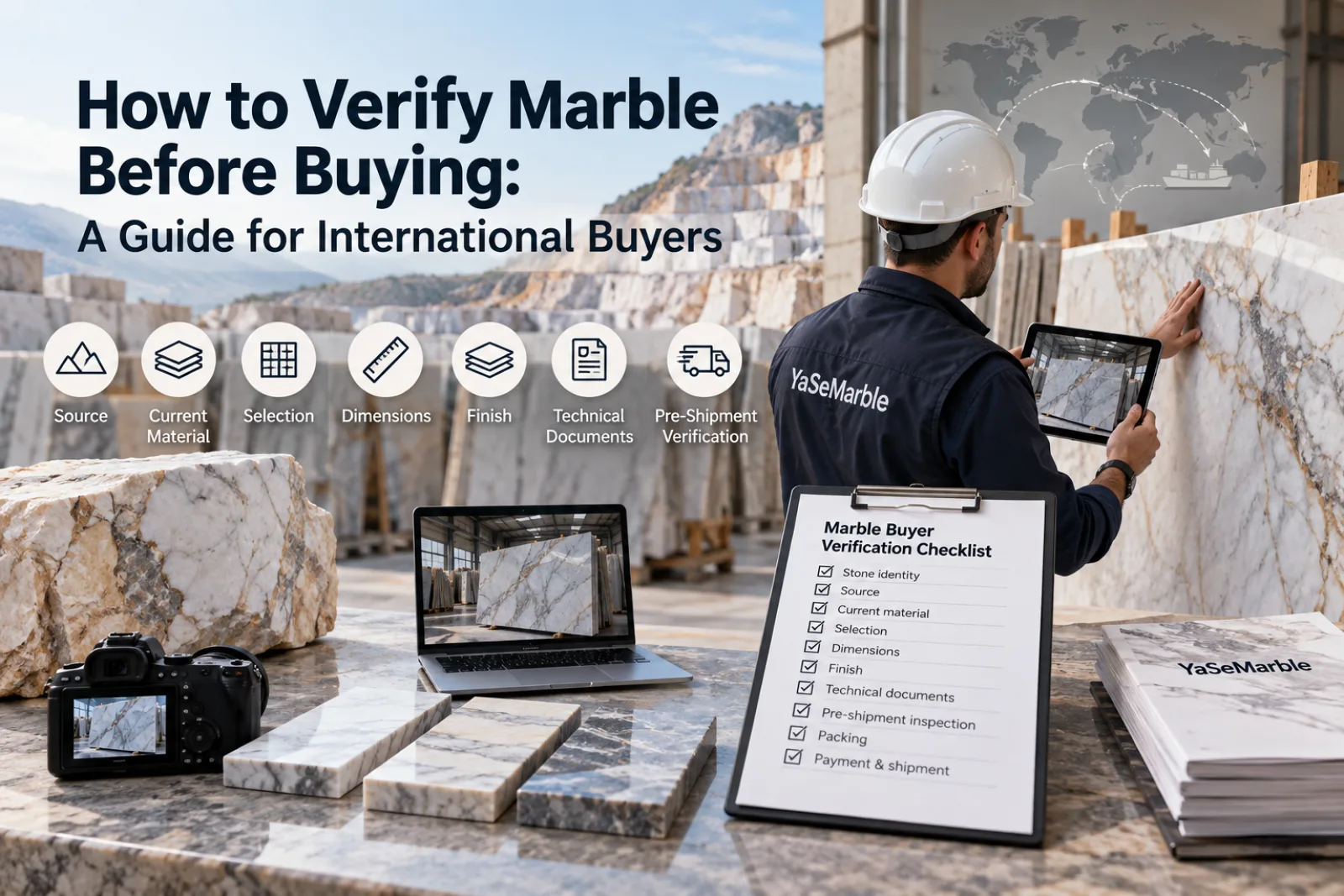
How to Verify Marble Before Buying: A Guide for International Buyers
🖼️Blog Visuals
How to Verify Marble Before Buying: A Guide for International Buyers
Short on time? [Download the Free Marble Buyer Verification Checklist →]
When buying natural stone internationally, the most important question is not simply:
“What is the price per square metre?”
It is:
“How do I know exactly what material I am buying?”
A catalogue image shows what a marble can look like. A quotation shows what a supplier wants to charge. Neither, by itself, proves what will actually be produced and shipped for your project.
Natural stone varies from block to block and slab to slab. Colour, veining, movement, pores, fissures, filling and overall appearance can change even within the same commercial stone name.
For international buyers, material verification should therefore be a defined part of the purchasing process.
This guide explains what to verify before production starts and what to check before the final balance payment or shipment, depending on the agreed payment terms.
1. Verify the Exact Stone and Source
The commercial name of a stone is only the starting point.
A professional quotation should identify, where commercially available:
Commercial stone name
Stone type
Quarry or source region
Producer or processing factory
Product form
Current production lot or stock basis
Intended application
Two suppliers may quote the same commercial marble name while offering material from different sources or different selections.
Comparing only the stone name and price can therefore produce a misleading result.
The first question should be:
“What exact material and source are included in this quotation?”
2. Ask for Current Material, Not Only Catalogue Photos
A catalogue photograph proves that a stone exists.
It does not prove that the same material is available for your order today.
Ask whether the photographs show:
The current production lot
Current stock
A previous shipment
A generic marketing sample
Material that still needs to be produced
For large orders, request dated photographs and video of the actual material whenever possible.
The closer the visual evidence is to the material being purchased, the less uncertainty remains.
3. Define the Acceptable Selection Before Production
Words such as premium, first quality, standard, commercial or extra do not have one universal visual definition across the natural stone industry.
Define the selection through evidence instead.
Acceptable
Agreed colour range
Agreed vein movement
Agreed level of natural variation
Agreed filling or resin treatment
Agreed surface finish
Not acceptable
Colour outside the agreed range
Unacceptable structural cracks
Unagreed repairs
Excessive shade variation
Incorrect finish or treatment
For large projects, a control sample and current production-lot visuals provide a much stronger reference than an adjective such as “premium.”
4. Check the Product Form, Dimensions and Finish
A quotation for random slabs cannot be compared directly with a quotation for fabricated cut-to-size pieces.
The offer should clearly state:
Slab, tile, block, cut-to-size or paver
Length and width
Finished thickness and tolerances
Surface finish
Edge profile
Cutting direction
Quantity
Drawing or BOQ revision for project work
A low price may simply mean that fewer production requirements have been included.
5. Understand What the Technical Documents Actually Prove
Technical documents should be connected to the material being offered.
Depending on the product and destination, you may need:
EN test reports
Declaration of Performance
CE-related documentation where applicable
Quarry or source information
Product-specific technical data
The important question is not:
“Does the supplier have a test report?”
It is:
“Does this document correspond to the actual source and product being offered?”
Always check that the documentation comes from the confirmed source rather than being copied from another quarry.
6. Verify the Actual Material Before Production or Final Approval
The verification method should match the product.
Slabs
Current photographs
Live or recent video
Bundle identification
Dimensions
Finish
Visual selection
Quantity
Tiles
Current production photographs
Dimensions
Thickness
Finish
Selection
Packing basis
Cut-to-Size
Drawing revision
Piece dimensions
Finish
Edge details
Piece coding
Dry-lay where required
Crate mapping
Blocks
Block number or lot
Dimensions
Estimated volume
Colour
Vein direction
Visible structural condition
Loading feasibility
The objective is not simply to collect photographs.
It is to connect the actual material with the commercial specification.
7. Make Pre-Shipment Verification Part of the Commercial Process
There is another important control point:
before the material leaves the factory.
At this stage, you can verify the actual bundles, slabs, crates or finished products rather than relying only on an earlier sample.
A pre-shipment check can include:
Current photographs and video of the actual material
Bundle, slab or crate identification
Quantity reconciliation
Dimensions and thickness
Finish
Selection criteria
Packing and labels
Packing list
Required documents
For international orders, this matters even more because correcting a discrepancy after shipment is considerably harder than identifying it before loading.
How YaSeMarble Approaches Verification
The difference between a supplier's promise and a useful verification process is evidence.
At YaSeMarble, the process starts with your specification rather than a generic catalogue request.
We identify suitable Turkish sources and work with the confirmed source to establish what material is actually available.
Our standard quotation process includes:
1. Current material evidence
Current photographs and, where available, video of the actual material being considered — not only catalogue images.
2. Source-specific documentation
Technical documents are checked against the proposed source and product.
3. Written selection basis
The quotation states the stone, product form, dimensions, finish, quantity and selection basis, so you know exactly what is being priced.
For applicable projects, we also provide:
4. Pre-shipment visual verification
Photographs or a live video inspection of the actual slabs or finished material, with bundle or crate identification where applicable.
5. Material identification and labelling
Applicable finished material can be identified by stone name, size, finish, quantity and crate number, creating a clear link between the approved material and the shipment.
We do not ask you to trust a photograph.
We use photographs, video, documents and written specifications together as one verification process.
What You Should Receive Before Approving a Large Order
Verification point | What you should see |
|---|---|
Stone identity | Commercial name + stone type |
Source | Quarry/region + producer where available |
Current material | Current photos/video |
Selection | Defined visual criteria |
Dimensions | Exact size and thickness |
Finish | Clearly stated finish |
Quantity | m² / pieces / blocks / estimated volume |
Documentation | Source-appropriate technical documents |
Packing | Agreed packing method |
Shipment | Loading and shipping basis |
Payment | Written payment terms |
Pre-shipment control | Agreed inspection/visual verification |
The purpose is not to eliminate natural variation, which is impossible with geological material.
The purpose is to make the acceptable variation explicit before production starts.
10 Questions to Ask Your Turkish Marble Supplier
Is this image from the current material being quoted?
Where does the material come from?
Which producer or factory will process it?
What selection is included in the price?
Can you provide current photographs and video?
What dimensions, thickness and finish are included?
Which technical documents apply to this exact source?
How will the approved selection be referenced during production?
Can the finished material be inspected before shipment?
What will be verified before the final balance or loading, according to the agreed payment terms?
If a supplier cannot answer these clearly, the supplier is not necessarily unreliable.
The purchase simply has not been defined well enough yet.
Download the Marble Buyer Verification Checklist
We have turned these questions into a practical checklist for international buyers comparing Turkish marble suppliers.
The checklist covers:
Stone identification
Source verification
Current material
Selection
Dimensions
Finish
Technical documentation
Pre-shipment inspection
Packing
Payment and shipment controls
[Download the Free Marble Buyer Verification Checklist →]
Request a Verified Marble Quotation from Türkiye
If you already know the stone, quantity and destination, you do not need to contact dozens of Turkish factories separately.
Send us:
Stone or reference image
Product form
Dimensions and thickness
Finish
Quantity
Destination port
Required delivery date
Any specific selection requirements
We identify suitable Turkish sources, compare the options and prepare a quotation based on your actual project requirements.
[Request a Marble Quotation →]
Related YaSeMarble Guides
[How We Work: From Quarry to Your Port]
[How to Compare Turkish Marble Quotes: 12 Checks Before You Choose a Supplier]
[How to Import Marble from Turkey: Step-by-Step Guide]
[Turkish Marble Blocks: Sourcing & Trade Guide]
Verify the material. Define the specification. Approve the production.
YaSeMarble helps international buyers source and verify Turkish natural stone with greater transparency from supplier selection to shipment.