
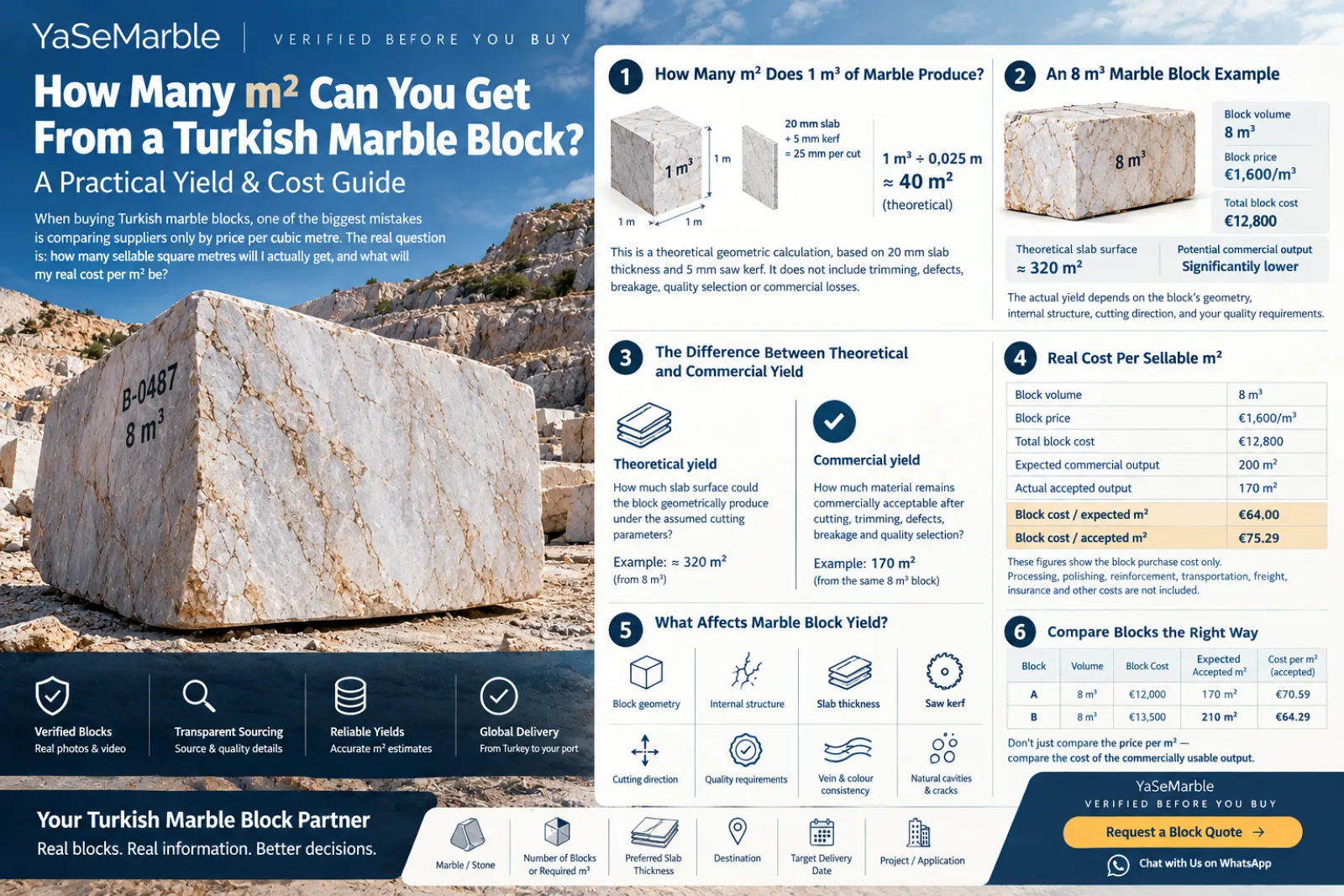
How Many m² Can You Get From a Turkish Marble Block? A Practical Yield & Cost Calculation Guide
🖼️Blog Visuals
How Many m² Can You Get From a Turkish Marble Block? A Practical Yield & Cost Calculation Guide
One of the most common mistakes when buying Turkish marble blocks is comparing suppliers based only on price per m³.
A block priced at €1,200/m³ may appear cheaper, while another block priced at €1,600/m³ may appear more expensive.
However, the block price alone does not tell you how many m² of commercially usable marble you will actually obtain after processing.
The real question is:
How many sellable m² can I realistically get from this block, and what will my actual cost per usable m² be?
In this guide, we explain how to calculate the theoretical yield of Turkish marble blocks, the difference between theoretical production and commercially usable production, and how a block should be evaluated before purchase.
1. How Many m² of Slab Can You Get From 1 m³ of Marble?
The first calculation is theoretical.
Let's assume that a block contains 1 m³ of marble and that the nominal slab thickness is 20 mm.
If we assume approximately 5 mm of saw kerf, the total thickness consumed during each cutting cycle is approximately:
20 mm + 5 mm = 25 mm
Therefore:
1 m³ ÷ 0.025 m ≈ 40 m²
This is a theoretical geometric calculation based on the specific assumption of a 20 mm slab + 5 mm saw kerf.
This figure is not a guarantee of directly sellable m².
The following losses have not yet been taken into account:
edge trimming
irregular block geometry
cutting losses
cracks
natural cavities
structural defects
slab breakage
quality selection
commercially rejected slabs
Therefore, 1 m³ ≈ 40 m² is a simplified theoretical reference for this specific 20 mm + 5 mm example. It is not a universal production-yield figure applicable to all marble.
2. An 8 m³ Marble Block Example
Now consider a marble block with a volume of:
8 m³
Slab thickness:
20 mm
Saw kerf:
5 mm
The theoretical calculation is:
8 ÷ 0.025 ≈ 320 m²
Under these assumptions, an 8 m³ block can theoretically represent approximately 320 m² of slab surface.
However, this does not mean that the buyer will receive 320 m² of sellable slabs.
This distinction is extremely important.
Theoretical production
≈ 320 m²
Commercially usable production
This may be significantly lower depending on the actual condition of the block and the buyer's quality requirements.
For this reason, a professional block purchase should not be based on theoretical yield alone.
3. The Difference Between Theoretical Yield and Commercial Yield
There are two different questions here:
Theoretical yield
How much slab surface can the block geometrically produce under specific cutting parameters?
Commercial yield
How many m² of material can actually be commercially accepted after cutting, edge trimming, defects, breakage and quality selection?
For example, an 8 m³ block may have:
≈ 320 m² of theoretical slab surface
However, for a specific project, the buyer may ultimately accept:
170 m²
The entire difference should not automatically be considered physical "waste."
Part of the material may:
be lower grade,
be suitable for another application,
fall outside the buyer's required color range,
be unsuitable for a specific project,
be lost during processing.
Therefore, in purchasing decisions, one of the most important figures is often:
commercially accepted m²
4. The Real Block Cost Per Sellable m²
Consider a simplified purchasing example.
Block
8 m³
Price
€1,600/m³
Total block purchase cost
8 × €1,600 = €12,800
Suppose the buyer initially expects:
200 m² of commercially usable material
In this case, the expected block cost per m² is:
€12,800 ÷ 200 = €64/m²
However, if the final commercially accepted output is:
170 m²
then:
€12,800 ÷ 170 = €75.29/m²
Calculation | Result |
|---|---|
Block volume | 8 m³ |
Block price | €1,600/m³ |
Total block cost | €12,800 |
Theoretical slab surface* | ≈320 m² |
Expected commercial production | 200 m² |
Actual accepted production | 170 m² |
Expected block cost per m² | €64.00 |
Actual accepted block cost per m² | €75.29 |
*Simplified theoretical calculation based on a 20 mm slab + 5 mm saw kerf assumption.
Important: These figures represent the block purchase cost only. Gang-saw/slab cutting, polishing, resin, reinforcement, transportation, freight, insurance, handling and other processing costs are not included.
5. Why Can a More Expensive Block Have a Lower Real Cost?
Consider two different blocks.
Block A
€12,000
Expected commercially accepted production:
170 m²
Block cost per m²:
€70.59/m²
Block B
€13,500
Expected commercially accepted production:
210 m²
Block cost per m²:
€64.29/m²
Block A | Block B | |
|---|---|---|
Total block cost | €12,000 | €13,500 |
Commercial production | 170 m² | 210 m² |
Block cost per accepted m² | €70.59 | €64.29 |
Block B has a higher purchase price.
However, it is also expected to produce more commercially usable material.
This example shows why block price alone should not determine the purchasing decision.
The comparison should be based on expected commercial production and the overall processing economics.
6. What Determines Marble Block Yield?
Actual production depends on many factors.
Block geometry
A more regular and rectangular block makes yield calculations easier.
Irregular edges can create additional cutting and trimming losses.
Internal structure
Natural stone may contain:
cracks
vein breaks
cavities
weak zones
natural inclusions
geological variations
These can affect the amount of usable production.
Slab thickness
Producing 20 mm, 30 mm or other slab thicknesses changes the theoretical cutting calculation.
Saw kerf
A certain amount of material is lost as cutting allowance during the sawing process.
The actual saw kerf can vary depending on the machine and cutting technology used.
Cutting direction
The direction in which the block is opened can significantly affect the pattern of the slabs and their commercial suitability.
Quality requirements
The material accepted by a distributor selling a broad product range may be different from the material accepted for a luxury project requiring a specific color range.
Therefore, there is no single "correct yield" figure for every block.
7. The Real Block Is More Important Than the Catalogue Photo
Natural stone is a geological product.
A catalogue photograph of a marble variety may not represent the actual block currently available for sale.
Before purchasing a block, information about the actual block being offered for sale should be requested.
At minimum:
current photographs
video when necessary
block dimensions
block volume
block number/reference
quarry and source information
visible cracks or cavities
color range
vein characteristics
recommended cutting direction
estimated commercial production
This approach forms the foundation of YaSeMarble's:
Verified Before You Buy
philosophy.
The goal is to reduce the uncertainty between the material the buyer sees online and the actual material they purchase.
8. What Should International Buyers Ask a Turkish Marble Supplier?
Before requesting a quotation, provide as much specific information as possible.
Stone
Marble name or product reference.
Quantity
Number of blocks or required total m³.
Intended application
For example:
slabs
flooring
wall cladding
countertops
hotel projects
residential projects
wholesale
distribution
Target thickness
For example:
20 mm / 30 mm
Destination
Country, city or port.
Delivery requirement
Target shipment or delivery date.
Commercial terms
For example:
EXW / FOB / CIF / another agreed Incoterms® 2020 rule
The clearer the request, the more meaningful the supplier's quotation and yield estimate will be.
9. How Can You Compare Turkish Marble Blocks More Accurately?
Do not compare blocks only like this:
Block | Price |
|---|---|
A | €1,300/m³ |
B | €1,500/m³ |
C | €1,700/m³ |
Instead, make a yield-adjusted comparison.
Block | Volume | Block Cost | Expected Accepted m² | Block Cost Per Accepted m² |
|---|---|---|---|---|
A | 8 m³ | €10,400 | 150 m² | €69.33 |
B | 8 m³ | €12,000 | 190 m² | €63.16 |
C | 8 m³ | €13,600 | 220 m² | €61.82 |
These are example figures, not production guarantees.
The purpose is to demonstrate the purchasing principle:
Do not compare only the price of the raw block. Compare the cost of the commercially usable output.
10. The Calculation Should Not Stop at Block Cost
For a complete purchasing analysis, the following costs should also be considered:
Block cost
Cutting
Resin / reinforcement
Polishing
Edge trimming
Quality control
Inland transportation
Port / handling
Freight
Insurance, where applicable
÷
Final commercially usable m²
This produces a more meaningful result:
Effective Delivered Cost Per Sellable m²
The exact calculation will depend on what the buyer is purchasing and which costs are included in the processing arrangement.
11. "Lower Quality" Is Not the Same as "Waste"
A slab may not be suitable for one project while still retaining commercial value.
For example, a slab with heavier veining may not be suitable for a project requiring a highly uniform color, but it may still be suitable for:
residential interiors
decorative walls
table applications
hotel areas
small-scale custom production
Therefore, yield calculations should distinguish between:
Physical processing loss
and
Material separated due to commercial quality selection
This distinction can significantly change the economic value of a block.
12. Why Are Current Photos and Videos Important?
When purchasing marble remotely, current visual verification is particularly important.
What should be requested is:
The actual block being offered for sale.
Whenever possible, the buyer should verify:
different faces of the block
dimensions
block number/reference
surface condition
visible cracks and cavities
color
vein structure
condition of surrounding material, where relevant
This does not replace a physical inspection or on-site assessment when one is necessary.
However, it is an important way to increase transparency before making a purchasing decision.
13. Turkish Marble Block Purchase Checklist
Before approving a block:
☐ Photos of the actual block
☐ Current video when necessary
☐ Block number / reference
☐ Dimensions
☐ Gross volume
☐ Quarry / source information
☐ Color range
☐ Vein characteristics
☐ Visible cracks
☐ Natural cavities
☐ Cutting direction
☐ Target slab thickness
☐ Estimated theoretical production
☐ Estimated commercial production
☐ Quality selection criteria
☐ Inspection / verification conditions
☐ Incoterms® 2020 term
☐ Loading point
☐ Freight estimate
☐ Payment terms
☐ Delivery schedule
The objective is simple:
Know what you are buying before you pay.
14. Frequently Asked Questions
How many m² of slab can you get from 1 m³ of marble?
This depends on slab thickness and saw kerf. For example, assuming a 20 mm slab + 5 mm saw kerf:
1 m³ ÷ 0.025 m ≈ 40 m²
of theoretical slab surface can be calculated.
This is not a guarantee of sellable m².
How many m² of slab can you get from an 8 m³ marble block?
Assuming a 20 mm slab + 5 mm saw kerf:
8 ÷ 0.025 ≈ 320 m²
of theoretical slab surface can be calculated.
Actual commercial production may be lower depending on the condition of the block, cutting process and quality requirements.
Is 320 m² guaranteed for an 8 m³ block?
No.
This is only a theoretical geometric calculation; it is not a guarantee of production or sellable m².
Is block price or yield more important?
Both are important.
A lower block price does not necessarily mean a lower cost per sellable m².
Can a supplier guarantee an exact yield?
An exact yield should not normally be assumed before the block is processed.
The supplier can provide an estimate based on the actual block, cutting parameters and agreed quality criteria.
What should I request before buying a Turkish marble block?
You should request current photographs or video of the actual block, its dimensions, volume, source information, quality characteristics, cutting requirements, estimated production, inspection conditions and commercial terms.
15. Conclusion
When buying a Turkish marble block, do not ask only:
"What is your price per m³?"
Ask instead:
"How much commercially usable production should I expect from this specific block, and what will my effective cost per sellable m² be?"
The purchasing chain should be evaluated as:
Block → Cutting → Theoretical Production → Processing Loss → Quality Selection → Commercial Production → Effective Cost per m²
This approach provides a much more reliable purchasing framework for international marble importers, processors, fabricators and distributors.
Our approach at YaSeMarble:
Verified Before You Buy
Before purchase, we can provide information about the available material based on the actual block, dimensions, photographs, video when necessary, quality characteristics and your project requirements.
If you are sourcing Turkish marble blocks, send us:
Marble / Stone:
Number of Blocks or Required m³:
Preferred Slab Thickness:
Destination:
Target Delivery Date:
Project / Application:
We can evaluate available material according to your requirements and prepare a tailored sourcing quotation.
Get a Turkish Marble Block Quote →
Contact YaSeMarble on WhatsApp →