
← Blog Listesine Dön
How to Inspect Turkish Marble & Travertine Slabs: 20-Point Checklist
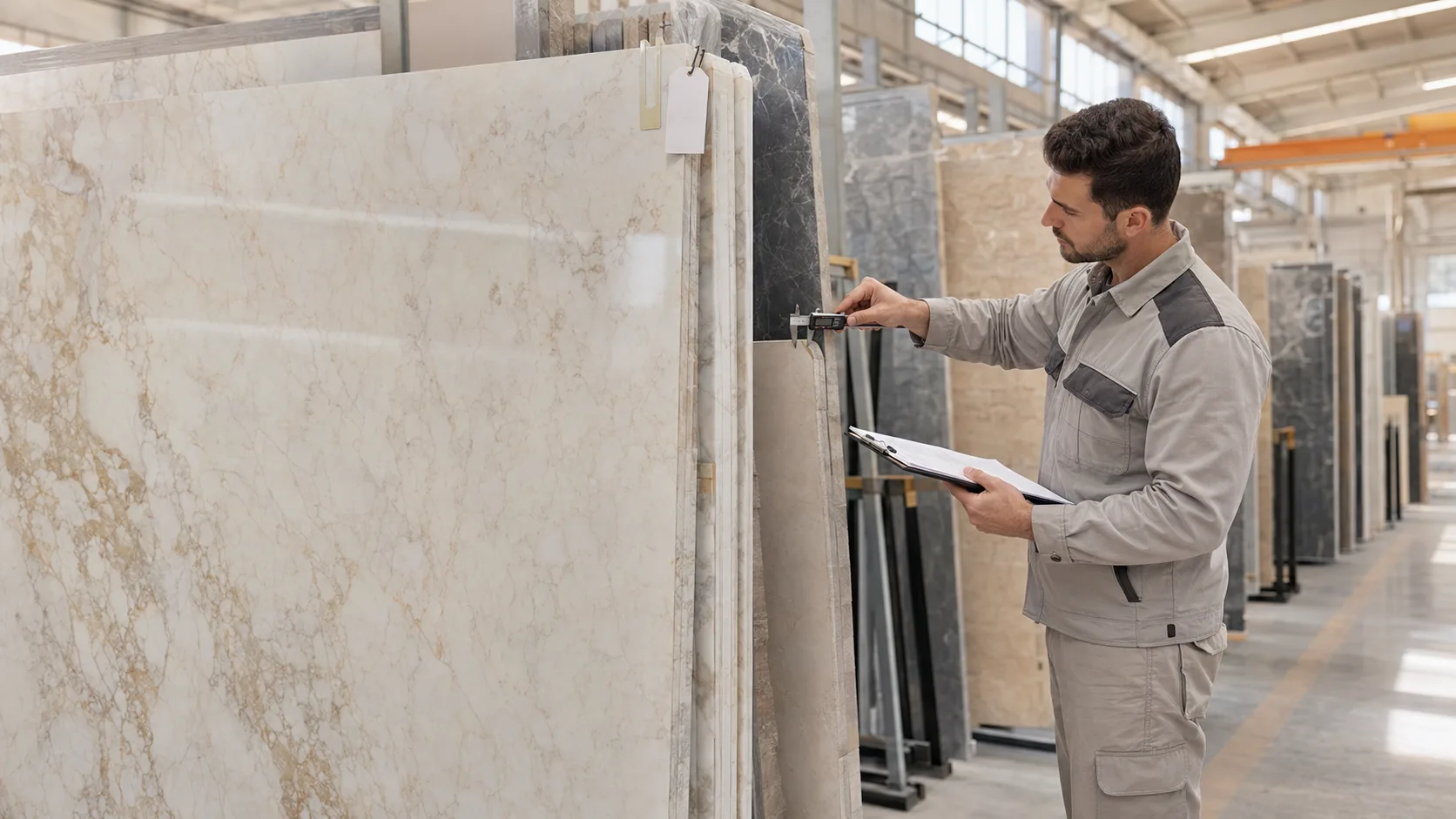
How to Inspect Marble & Travertine Slabs Before Buying from Turkey: 20-Point Checklist
Many disputes in the natural stone trade do not begin with visibly defective material. They begin when the actual slabs, documents and commercial terms are not checked clearly before approval. Here's what to check before you approve a marble or travertine slab order from Turkey.
Documentation
1. Ask for the bundle or lot reference, and where available the block, quarry or production source — not just the commercial stone name. Two lots sold under the same name can look noticeably different.
2. Confirm which product standard applies. EN 1468 covers rough slabs for further fabrication; EN 1469 covers finished cladding; EN 12058 covers finished floor/stair slabs; EN 12057 covers tiles. The applicable standard depends on the finished product, not the stone name.
3. Request the DoP and test reports for the relevant product type and declared source. A DoP is tied to a product type, not issued per block or bundle — but it must correspond to the actual stone and source supplied.
4. Compare declared test values against your project spec, fixing system and local regulations. There's no single global threshold; exterior use in freeze-thaw climates may also need durability/freeze-thaw data.
5. Confirm the required document set in advance — invoice, packing list, bill of lading, certificate of origin and, where applicable, ATR (a movement certificate, not a certificate of origin) or destination schemes like SABER. Check with your customs broker which apply to your shipment.
Visual & Material Inspection
6. Review current slab or bundle photos, not catalogue images. Ask for recent daylight photos of the actual bundle.
7. Ask whether slabs were cut sequentially and request the slab sequence where bookmatching matters. A sudden pattern shift may signal mixed production, but isn't automatically a defect — ask the supplier to explain it.
8. Agree the acceptable shade and movement range using bundle photos or a control sample, with light/medium/dark reference pieces for project orders — rather than one small sample standing in for the whole lot.
9. Ask about fissures, cracks and reinforcement, not just what's visible in front-face photos. For high-value material, request slab-back photos and close-ups of repaired areas; consider an independent inspection where structural condition is critical.
10. For travertine, confirm filled vs. unfilled. Filled suits smooth polished interiors; unfilled keeps its open texture for rustic or exterior use. This changes both look and maintenance.
11. Check the finish is uniform corner to corner. Uneven sheen may mean inconsistent processing, residue, moisture or just lighting — ask for extra daylight photos or gloss measurements if it matters commercially.
12. For travertine and other bedded stones, confirm vein-cut vs. cross-cut. Not every marble is classified this way — verify against actual photos, not the name.
Technical & Dimensional Checks
13. Verify nominal thickness, tolerance class and the actual measured range of the bundle. Tolerances vary by standard, product and finish; get the accepted range written into the quotation.
14. For tiles, confirm calibration and rectification separately — calibrated means consistent thickness, rectified means squared edges. A tile can be one without the other.
15. Request actual slab dimensions, not just a size category. "Jumbo" isn't a fixed measurement — it varies by supplier and stone.
16. Check edge condition, corner damage, squareness, flatness and warpage against the agreed spec and tolerance. Anything outside range should be flagged before shipment, not discovered after.
Bundle, Packing & Shipment
17. Confirm bundle/lot numbers are recorded and traceable to your order — essential if you need to file a claim later.
18. Ask for a dated video of the bundle before loading. It can reveal residue, inconsistent appearance or mismatched slabs, but won't reliably prove flatness or thickness — request straightedge checks or measurements where those are critical.
19. Confirm the packing system fits the slab's size, weight, finish and route. Large slabs are usually secured upright on A-frame/bundle systems; tiles and cut-to-size pieces in reinforced crates. For high-value orders, ask for packing drawings or loading photos.
20. Confirm where transport risk transfers, who insures the cargo, and how damage claims are handled — then get it all into one dated, written quotation naming the material, bundle, packing, Incoterm, port, payment terms and validity. Incoterms define risk and cost transfer; they don't replace a quality agreement or insurance policy.
The Short Version
Six things, at minimum: the bundle number, a recent photo or video of that exact bundle, the agreed shade/movement range, the fissure and reinforcement disclosure, a dated written quotation, and the point where transport risk and insurance responsibility transfer.
This checklist reflects the inspection points we recommend for international buyers ordering marble and travertine. Wherever bundle-specific stock is available, YaSeMarble provides current photographs, traceable lot information and supporting documents before final approval.
Request a Current Slab Offer
Send the stone name or reference image, thickness, finish, quantity and destination port. We'll check current Turkish production and, where available, provide actual bundle photos, dimensions, packing details and a dated FOB, CFR or CIF quotation.
Required information: Stone or reference image · Thickness · Finish · Quantity · Destination port · Required date
Email: info@yasemarble.com WhatsApp: +90 552 802 22 00